CO2 has a number of unique properties that make it ideal for use as a refrigerant in general and as refrigerant for booster systems in particular. The critical point of a substance is the point at which its liquid and vapor states cannot be distinguished. The critical point of CO2 for instance, is around 88 Fahrenheit and is lower than that of other refrigerants such as R-134a (214°F) and R-410a (162°F). Systems using these refrigerants operate in the subcritical region all of the time. Systems using only CO2 to reject heat to ambient temperatures, on the other hand, do not always operate in the subcritical region. That requires system designers to approach the heat transfer process somewhat differently than they would for more commonly used refrigerants.
.
As the
critical point is approached, the gas and liquid phases of a substance
advance toward one another,resulting
in only one phase at the critical point: a homogeneous supercritical
fluid. There is no distinction between
the two phases above this point. Above the critical temperature
no additional amount of pressure will cause
liquid to form.
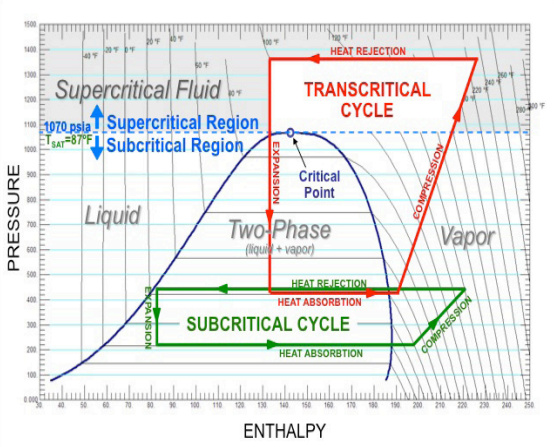
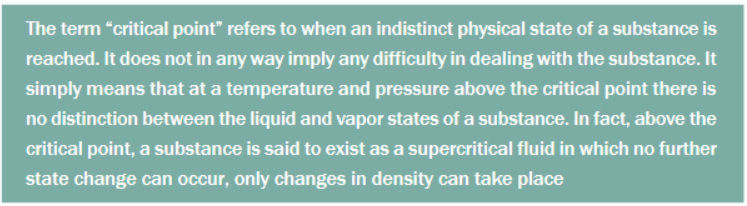
The critical point is important in understanding the operation of the CO2 booster system. With its use of compressors, the system works in some ways like any other direct expansion (DX) system but with a key difference. In a conventional DX system, the entire operation of the system takes place below the critical point, or in the subcritical region. Within this region, the refrigerant changes back and forth between only vapor and liquid. But as already pointed out, above the critical point another state is reached, that of a supercritical fluid and within that region no further state change such as condensation occurs.
Certain aspects of the Advansor system will be familiar to anyone who knows how a traditional DX system works. Like those systems, the Advansor system has four main components that include compressors, evaporators, condensers, and expansion valves. Additionally, the system uses two types of specialized valves: a high-pressure control valve and a flash gas bypass valve. Another key difference from traditional systems is that functionally the system operates as what is known as a two-stage booster system with the same refrigerant moving between the low and medium-temperature compressors. The low-temperature compressors discharge to the suction of the medium-temperature compressors. In other words, the medium-temp compressors serve as a booster to the low-temp compressors.
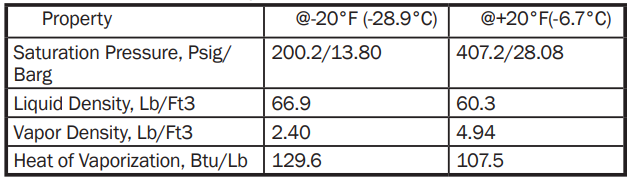
Suction gas from the low-temperature display case and freezer evaporators enters the low-temperature subcritical compressors at around 200 psig, well below the critical point for CO2. The low-temp discharge gas at about 400 psig, then combines with the medium-temp suction gas from the medium-temp display cases and walk-in cooler evaporators before entering the medium-temp transcritical compressors. The medium-temp discharge gas leaves the compressors, depending on ambient conditions, anywhere from 560 psig to as much as 1450 psig, which is above the critical point. The medium-temperature compressors normally operate at pressures from 855 to 1290 psig depending upon ambient conditions.
.
Under
warmer conditions in which the pressure rises above 1055 psig,
the system enters the transcritical
range.
Under either condition, however, hot discharge gas from the medium-temp
compressors feeds to a
condenser/gas
cooler where, as with any refrigeration system, the heat is rejected
to the outside environment.
The
page which follows depicts a simplified piping layout of an Advansor
Booster System. Please take a fewminutes
to study this piping layout to gain an understanding of the locations
of the various components and their
locations relative to each other.
Simplified Diagram of the Advansor Booster System Piping
The sizing of the compressors on the low-temperature and medium-temperature stages of the system is carefully determined to provide optimal capacity control during partial load operation. The condenser/gas cooler design is optimized to accomplish high-performance, even at high ambient temperatures when the system is operating in the transcritical range. (More about how these components work and their specific operation is described in greater detail in the next section.). The CO2 leaving the condenser/gas cooler feeds to a high-pressure control valve that regulates the flow of CO2 into an intermediate pressure receiver, called a flash tank. The gas enters the valve at 560 to 1450 psig, depending on ambient conditions, and exits at approximately 540 psig.
The valve is designed to work somewhat like a hold-back valve in order to maintain optimum pressure through the condenser/gas cooler for the most efficient operational performance of the system. Liquid refrigerant is supplied to the medium and low-temperature evaporators controlled by conventional electronic expansion valves. Vapor from the flash tank is fed through the flash gas bypass valve back to the medium-temperature compressors. The flash gas bypass valve maintains a constant pressure in the flash tank.
Apart from some of the unique components just described, the system works in a similar way to other types of DX systems. The main differences are related to the two-stage design of the system and that all of the evaporators in the system are supplied with liquid from the same source. For most experienced technicians the system will not seem overly complicated.